
by Shawn Carlson SCIENTIFIC AMERICAN January 1999
Most folks think about the earth's magnetism only when they
need to find their way in the wilderness. When we look at a compass, the
earth's magnetic field appears to be a steady guide. But in reality the
magnetic field is anything but stable. Ephemeral undulations, called
micro-pulsations, ripple about the ionosphere and generate magnetic
disturbances that reach down to ground level. Although they are common and
sometimes last from seconds to minutes, these magnetic disturbances are
hard to detect, having barely one ten-thousandth the strength of the
earth's average magnetism.
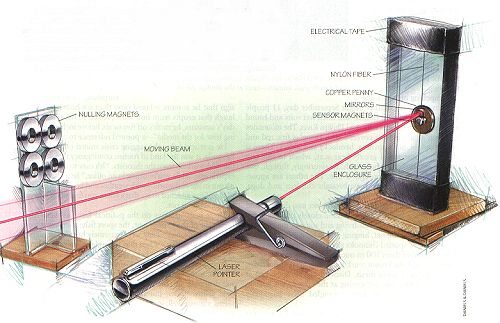 REFLECTED BEAM from this laser pointer will
oscillate visibly when the earth's magnetic field in the
horizontal direction varies by even a tiny amount-as it will when
ionospheric storms create magnetic micro-pulsations. To
investigate the field's vertical component the equipment must be
mounted with the magnets parallel to the ground. (Note: In this
diagram the plane of the nulling magnets, which should be parallel
to the plane that the penny lies in, has been rotated slightly to
provide a better view of the equipment.)
REFLECTED BEAM from this laser pointer will
oscillate visibly when the earth's magnetic field in the
horizontal direction varies by even a tiny amount-as it will when
ionospheric storms create magnetic micro-pulsations. To
investigate the field's vertical component the equipment must be
mounted with the magnets parallel to the ground. (Note: In this
diagram the plane of the nulling magnets, which should be parallel
to the plane that the penny lies in, has been rotated slightly to
provide a better view of the equipment.)
For decades, the high cost of sensitive magnetometers has
made tracking these signals the exclusive privilege of professionals. But
now, thanks to the creative genius of Roger Baker, a gifted amateur
scientist in Austin, Tex., anyone can easily study magnetic
micro-pulsations. Baker's magnetometer costs less than $50, yet it can
easily capture those tiny pulsations as well as the occasional dramatic
effects of a magnetic storm high in the ionosphere.
Baker's device employs one of the most sensitive instruments in science.
It's called a torsion balance, and it measures a force by using it to
twist a fine filament. The thread gently resists rotation with a torque
that grows until it just balances the torque created by the applied force.
The resulting angle of deflection, which is found by bouncing a light beam
off a small mirror attached to the filament, is proportional to the force
under study. With the beam from a laser pointer and a match-head-size
mirror, one can in principle resolve deflections as small as one
ten-millionth of a degree.
Most professional torsion balances use fine quartz fibers, which are
incredibly strong and insensitive to changes in humidity and temperature.
Sadly, quartz fibers are difficult for amateurs to come by. But Baker has
found that nylon fibers also work quite well. Start with silky,
multifilamented nylon twine, which you can purchase at any hardware store,
and cut a 30-centimeter (one-foot) length. Next, gently unravel it and use
tweezers to select the finest strands, which should be about 25 microns
(0.001 inch) thick.
Baker installs the nylon filament into a simple case made from window
glass. Cut two strips five centimetres wide and 15 centimetres long using
a glass cutter. (Most hardware vendors sell glass and will also cut it for
a nominal fee.) These pieces serve as the vertical walls of the case. Then
cut eight glass strips one centimetre wide by five centimetres long and
use silicone cement to glue pairs together back to back. Finally, glue one
pair of these small glass strips to the top and one to the bottom of each
of the longer glass walls. The smaller pieces will act as spacers between
the walls.
'When the glue sets, cover the horizontal spacers of one of the walls with
a layer of stretchy, black vinyl electrical tape. The tape prevents the
glass from cuffing the fiber. Next, lay one end of the fiber across the
center of the top spacer and tack it in place with a small dollop of
epoxy; secure it with another strip of tape. The epoxy will keep the
thread from slipping over time.
Baker generates the necessary tension in the fiber by dangling four
nickels attached temporarily to the end. He then epoxies and tapes the
lower end of the thread into place against the bottom spacer, locking in
the tension.
To coax the nylon to twist in response to minute changes in the ambient
field, you need to affix a powerful magnet to the fiber. Because a large
and massive magnet responds only sluggishly, the ideal attractor would
possess a powerful field and yet be extremely lightweight. Such magnetic
miracles exist; they are called rare-earth magnets because they contain
rare-earth elements, such as samarium. These marvels are tiny and yet
harbor at their surface magnetic fields that are 10,000 times stronger
than the earth's. Best of all, you can pick up a pair of them at any Radio
Shack for less than $2 (part number 64-1895).
Deposit a thin smear of silicone cement on one rare-earth magnet and
sandwich the filament between the two of them. Make sure that they overlap
each other completely and are perfectly centered on the fiber as the glue
hardens. Baker fashioned the reflector from a small vanity mirror. With a
glass cutter he cut 1.5-millimeter-square chips, which he cemented to the;
back to back, centered on the fiber just above and in contact with the
rare-earth magnets. The mirror and magnets will then rotate as a
well-balanced unit. Baker notes that the instrument will work better if
you use the reflective surface on the back of the mirror to reflect light,
which avoids the possibility that passage through the glass will distort
the beam. To remove the lacquer that covers the reflective coating, use a
Q-Tip to rub a little MAGNETS methyl ethyl ketone (MEK) on the back
surface. If you would rather not work with a potentially toxic chemical,
then install the mirrors in the usual way, with light passing through the
glass.
Baker next glues a solid-copper penny (one minted before 1982, when the
purity of the metal was still high) to the glass, just behind the magnets.
'When the magnets move, they induce electrical eddy currents in the copper
that in turn produce their own magnetic fields, which oppose the motion of
the magnets. Baker's clever trick quickly damps unwanted oscillations,
making the magnetometer much easier to read.
Next, encase the sensor by gluing the second glass wall with its spacers
on top of the first and then seal off the sides with black electrical tape
to protect your magnetometer from pesky air currents. Mount the entire
assembly vertically to a smooth flat base. Your sensor is now an accurate
compass. As you walk around, the magnets should align to magnetic north
and display little oscillation.
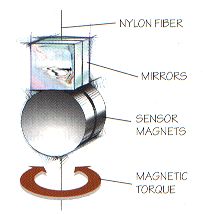 MIRROR pieces and a pair of powerful magnets
attached to a nylon fiber rotate in response
MIRROR pieces and a pair of powerful magnets
attached to a nylon fiber rotate in response
to changes in the magnetic environment.
Because the earth's relatively large field absolutely
overwhelms the coveted magnetic micro pulsations, you must first null the
instrument before it will register signals from the ionosphere. Baker's
procedure for doing so requires another trip to Radio Shack to acquire
four doughnut-shaped magnets (part number 64-1888). Attach them side by
side to a small piece of glass or wood using silicone cement. (Note that
you'll need to use small clamps to hold them in place against their mutual
magnetic repulsion until the glue sets.) Turn the array of doughnut
magnets upright and cement it to a free-standing base so that the center
of the assembly aligns with the rare-earth magnets in the sensor.
As the nulling magnets are brought close to the magnetometer
(approximately 30 centimetres), the sensor will begin to wobble and then
rotate quite freely when the combined forces of the earth's magnetic field
and those of the doughnut magnets almost cancel each other out. The period
of the oscillations should lengthen to a second or more when all the
forces are nearly balanced. In this configuration the magnetometer will be
the most sensitive.
The bright beam of a laser pointer completes the instrument. (Radio Shack
sells one pointer for less than $30.) Position the laser so that the beam
shines through the glass case and bounces off the mirror and onto a
distant wall. Ripples in the earth's magnetic field will show up as
deflections of the beam.
Although at this point you're ready to do real science, Baker has improved
the device further. By wrapping wire onto a rolled-oats container, he has
fashioned a pair of coils to calibrate his creation. He uses the so-called
Helmoltz arrangement of two circular coils (ones separated by half their
diameter) to make the magnetic field in the center uniform. Such Helmholz
coils can also be combined with photocells and electronic feedback to keep
the laser beam fixed as the earth's field changes. Measuring the current
needed to null the signal in this way shows the size of the magnetic
fluctuations. Using a computer to monitor the current will produce a
stream of measurements that you can record and later analyze.
For more details about this project, visit the Web forum hosted by the
Society for Amateur Scientists at < http://web2.thesphere.com/SAS/WebX.cgi
>. You may also write the society at 4735 Clairemont Square, Suite 179,
San Diego, CA 9217.
